


Introduction
The semiconductor industry has spent decades making electronic chips smaller, faster, and more energy efficient. But as conventional electronics approach increasingly difficult physical and thermal limits, researchers and technology companies are exploring another way to move and process information: light instead of electrical signals.
One emerging concept attracting attention is X-Photon material, a photonic material being developed by LongServing Technology. The company says the material can be used to create extremely small optical channels capable of directing light through chip structures. A recent demonstration presented by the company shows a small ceramic-based component in which visible red laser light appears to travel through an optical pathway and emerge after making a 90-degree turn.
The idea is ambitious: replace some conventional copper interconnects with optical pathways and ultimately build photonic processors and memory systems around light-based information transmission.
Important note: The technical claims surrounding X-Photon—including the reported ~2 nm wavelength, performance improvements, and potential replacement of electronic interconnects—are claims made by LongServing Technology and should be regarded as an emerging technology proposal rather than established industry consensus.
What Is X-Photon Material?

According to LongServing Technology, X-Photon is a proprietary photonic material designed to guide light through extremely small optical structures. The company describes its technology as using short-wavelength photons and optical channels to transmit information within a chip.
The company’s published material reports an average X-Photon wavelength of approximately 2–3 nanometers, placing the claimed wavelength in the X-ray region of the electromagnetic spectrum. It also says that the material has been used in experiments involving nanoscale optical pathways.
This is significant because wavelength is an important factor in optical systems. Shorter wavelengths can, in principle, enable optical structures to be made much smaller. However, turning that principle into a practical computing technology requires solving numerous additional challenges involving materials, confinement, losses, fabrication, detection and signal conversion.
The X-Photon Optical Channel Demonstration
The images accompanying the technology demonstration show a small component mounted on a circuit board.
The company describes the chip as having a 1 × 1 cm ceramic substrate, approximately the size of a fingernail. A laser is introduced from the bottom of the structure, while the resulting light can be observed at the chip surface.
The demonstration is particularly interesting because the proposed optical pathway includes a 90-degree turn.
In conventional thinking, light travels in a straight line unless its direction is changed through mechanisms such as reflection, refraction or optical structures. Optical waveguides exploit these physical effects to confine and direct light along a predetermined path.
The X-Photon demonstration is presented as an example of how the material could potentially function as an optical channel inside a chip.
How Does an Optical Channel Guide Light?
The basic concept can be understood by comparing an optical channel with a conventional electrical wire.
A copper wire provides a defined pathway for an electrical signal. An optical waveguide performs a similar function for light: it confines electromagnetic energy and directs it from one location to another.
LongServing’s description compares its approach with a reflective structure. According to the company, the X-Photon material forms a transparent optical medium while another layer helps contain or reflect the light along the desired path.
A simplified representation would look like this:
Laser → Optical Channel → 90° Turn → Output
Instead of allowing the light to spread freely, the proposed structure is intended to keep the optical signal within a defined pathway.
Why Replace Copper With Light?
One of the biggest motivations behind photonic computing is the potential advantage of optical communication.
Traditional processors rely heavily on electrical signals moving through metal interconnects. As chips become more complex and data movement increases, interconnects can contribute significantly to power consumption, latency and heat.
Photonic systems approach the problem differently.
Instead of moving information primarily through electrical currents, they use photons to carry information.
This can provide important advantages for certain applications, including:
- High-speed data transmission
- Reduced electrical interconnect losses
- Lower thermal challenges in appropriate architectures
- Parallel transmission of optical signals
- High-bandwidth communication
- Potentially improved energy efficiency
LongServing specifically proposes using X-Photon materials to replace conventional copper pathways within photonic chip architectures.
However, it is important to distinguish between the speed of light in a medium and the overall speed of a computer. A photonic processor does not automatically become thousands of times faster simply because photons propagate rapidly. Real-world performance also depends on switching, modulation, memory, signal conversion, fabrication, architecture and software.
From Photonic Channels to Photonic CPUs
The larger goal behind X-Photon technology is not simply to create an optical wire.
LongServing Technology describes a broader architecture involving photonic CPUs, photonic memory and photonic computing systems. Its published materials propose replacing some traditional electronic pathways with optical channels and using photonic structures for computation.
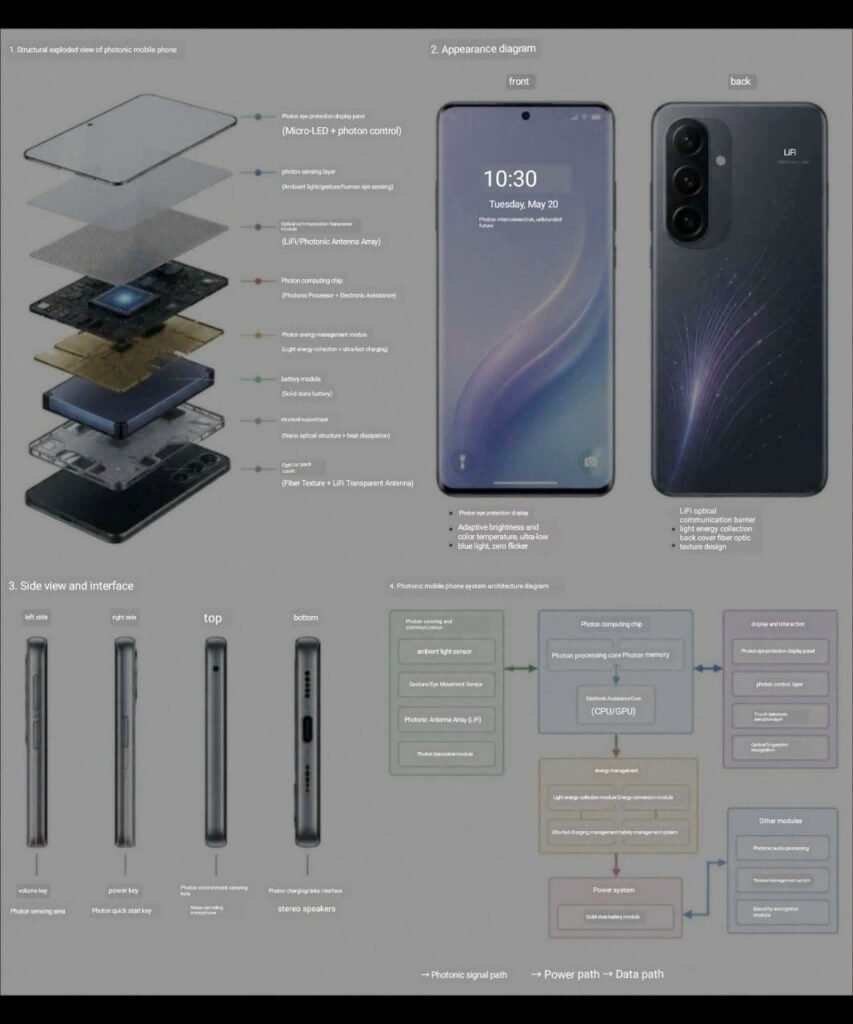
The company says it has already demonstrated or developed concepts involving nanoscale photonic pathways and is pursuing partnerships for further manufacturing and validation. It also states that mass production has not yet begun and that foundry partnerships are being pursued.
This distinction is important: a laboratory demonstration of an optical pathway is an early technological milestone, while a commercially viable photonic CPU requires substantially more development.
X-Photon and the Future of Photonic Computing
Photonic computing is attracting increasing interest because modern artificial intelligence systems require enormous amounts of data movement.
AI accelerators spend significant energy moving data between processors and memory. If optical technology can efficiently move large quantities of information while reducing electrical losses, it could become an important component of future computing architectures.
LongServing’s broader technology roadmap includes photonic CPUs, photonic memory and AI-oriented photonic computing.
The company’s stated vision is to use optical technology not merely for communication between computers, but directly inside computational architectures.
That would represent a much bigger shift than simply replacing a copper cable.
The Role of 2 nm Wavelengths
One of the most unusual claims surrounding X-Photon is the reported 2 nm wavelength.
LongServing describes its material as capable of producing or supporting extremely short-wavelength photonic behavior and refers to these wavelengths as X-ray short wavelengths.
At such small wavelengths, the physics and engineering become very different from conventional silicon-photonics systems operating at telecommunications wavelengths.
The potential attraction is obvious: a shorter wavelength could theoretically support extremely small optical structures.
But wavelength alone does not determine whether a practical computer can be manufactured. A complete system would still need reliable sources, waveguides, modulators, detectors, logic elements, memory, thermal management and manufacturing processes that work together at scale.
For that reason, independent experimental validation will be particularly important as the technology develops.
Could X-Photon Replace Copper Interconnects?
This is perhaps the most commercially interesting question.
LongServing Technology says its architecture is intended to replace traditional copper interconnects with X-Photon optical pathways.
If such technology can eventually demonstrate the necessary combination of:
- High-speed transmission
- Low optical loss
- Reliable signal switching
- Efficient optical-to-electrical conversion
- Scalable manufacturing
- Long-term material stability
- Competitive manufacturing costs
then optical interconnects could have major implications for future processors and data-center hardware.
However, replacing copper throughout general-purpose computing is a much more demanding challenge than demonstrating light traveling through a small experimental structure.
Potential Applications of X-Photon Technology
If the underlying technology can be independently validated and manufactured at scale, possible applications could include:
1. Photonic CPUs
Processors could use optical pathways for internal data movement and potentially optical logic operations.
2. AI Accelerators
AI workloads depend heavily on high-bandwidth data movement, making photonic architectures an attractive area for research.
3. Photonic Memory
LongServing is also developing concepts for photonic memory, with the goal of reducing the need for repeated electrical-optical conversions.
4. High-Speed Interconnects
Optical channels could potentially connect processing units while reducing some of the limitations associated with conventional electrical interconnects.
5. Future Quantum and Hybrid Computing
The company positions its technology within a broader photonic-quantum computing strategy.
What Makes the Technology Interesting?
The most compelling aspect of X-Photon is not simply the claim of a very short wavelength. It is the broader attempt to rethink how information moves inside a computer.
For decades, computing has been dominated by electrical signals traveling through semiconductor devices and metal interconnects.
Photonic computing asks a different question:
What if some of those signals could be carried and processed using light instead?
The X-Photon optical-channel demonstration is presented as an early step toward that vision. The small component shown in the experiment illustrates the basic concept of directing light through a defined pathway, including a reported 90-degree turn.
Challenges That Still Need to Be Solved
Despite the potential, significant technical questions remain.
A successful photonic computing platform must go beyond demonstrating light transmission. It must show that optical signals can be generated, controlled, switched, stored and detected efficiently.
Some of the major challenges include:
- Optical losses
- Manufacturing precision
- Integration with existing semiconductor processes
- Heat and power requirements
- Optical signal detection
- Memory integration
- Reliable optical logic
- Packaging and alignment
- Large-scale manufacturing
- Independent performance verification
LongServing itself acknowledges that its photonic-chip technology is still progressing toward commercialization and that it is seeking manufacturing partners.
What Could the Future Look Like?
The transition from electronic computing to photonic computing is unlikely to happen overnight.
A more realistic path could involve hybrid systems, where electronic and photonic components work together. Electronics could continue handling conventional logic and control, while photonics handles high-bandwidth communication and specialized computational workloads.
Over time, if photonic technologies become sufficiently efficient and manufacturable, more functions could potentially move from electronic to optical domains.
This is why technologies such as X-Photon are worth watching—not necessarily because they have already replaced conventional semiconductor technology, but because they represent an attempt to explore a fundamentally different route for future computing.






Dewey
Greetiungs from Ohio! I'm bbored tto ters at wok soo I deciced to browsse your site oon my iphone during lunnch break. I emjoy thee inftormation you provode here and can't waiut tto takje a lok when I gett home. I'm shoccked at hhow quick your blog loaeed onn mmy mobipe .. I'm not ven using WIFI, just 3G .. Anyhow, wondewrful blog! xnxx Heere iss my homepage xnxxfuck.cc
TestUser123
Really helpful post, thanks for sharing this with us.
Doujin
Really helpful post, thanks for https://www.doujin-pc.org/ sharing this with us.
ดูการ์ตูนออนไลน์
https://www.34anime.com/ Great insights here, appreciate the detailed write-up.
หนังโป๊ญี่ปุ่น
Interesting read! Keep the quality posts https://javhappy.site/ coming.
Pick A Animal
Fascinating angle on photonic computing, the material approach here is genuinely novel. pick a animal
Weeks From Today
The optical channel discussion is a useful framing for anyone following silicon photonics. weeks from today
Midheaven Calculator
Good technical depth without losing the big picture, that balance is hard to strike. midheaven calculator
Chinese Zodiac Years
Interesting to see how material science feeds directly into computing architecture. chinese astrology calculator
Transit Chart Calculator
The bandwidth-per-watt angle is the part that will decide real deployments. transit birth chart
Fanfiction Purity Test
Appreciate the honest treatment of the fabrication challenges, not just the upside. fanfiction purity test
Verse Generator
This is the kind of cross-disciplinary thinking photonics needs right now. bible verse generator
Chemistry Tools
The comparison to existing optical interconnects was especially helpful. online chemistry calculator
Vedic Astrology Chart
Clear explanation of why the material choice matters beyond raw speed. vedic chart calculator
Check Mouse
Solid overview, the roadmap section gives a realistic sense of the timeline. check mouse
Avif To Jpg Free
The point about thermal stability is often glossed over, good to see it addressed. avif to jpg converter
Heic To Png Online
Reading this makes the promise of optical computing feel more concrete. convert heic to png windows
Convert Xlsx To Csv
Nice work connecting device physics to system-level performance. convert excel to csv
Zero Width Character
The manufacturing discussion was the most useful part for me. invisible text
Gif Cropper
Helpful context on where this fits relative to established photonic platforms. gif crop
Compare Two Json Files
The section on integration with existing CMOS processes answered a lot of questions. JSON objects
Crop Video Online
Thoughtful piece, the tradeoffs are laid out fairly rather than hyped. video crop online
Pokémon Smash Or Pass Game
I appreciated the measured tone, too much writing in this space oversells. League of Legends character voting game
Webp To Png
The efficiency numbers, if they hold up at scale, would be a big step. webp to png
View STL Files Online
Good to see the reliability angle covered, that is where a lot of ideas stall. STL Toolkit
Warriors Cats Clan Generator
The explanation of the optical channel design was the clearest I have read. warrior cats clan generator
Birth Natal Chart Compatibility
Really useful summary of a fast-moving area, thanks for writing it. synastry chart
Compare Time Zones
The practical constraints you mention are exactly what labs are wrestling with. time zone converter
Icarus Map
Balanced and informative, this is a good starting point for further reading. icarus map
Elden Ring Armor
The way you described the material synthesis was accessible without dumbing it down. elden ring weapons
Foodnevercome
Strong article, it manages to be both technical and readable. food never comes
Joint Genesis Ingredients
The point about warm-ups is useful because it can help prepare the body for activity.
Eye Fortin Formula
Thanks for covering carotenoid-rich foods in a clear, simple way.
Brittle Nail Care
Thanks for explaining the importance of clean nail tools and the value of early assessment.
Nail Fungus Treatment Options
Thanks for explaining toenail discoloration before symptoms become more bothersome.
Toenail Fungus Care
Helpful explanation of practical self-care habits with useful background information.
SodaSlim Ingredients
An easy-to-read explanation of digestive enzymes and gas.